Between a circle and a square lies the smallest gap geometry allows — and perhaps the deepest one physics has yet to understand.
Dedicated to François Viète (1540–1603),
whose nested radicals revealed the infinite geometry
between the circle and the square,
and in doing so, hinted at the balance of opposites that underlies all creation.
Time has no beginning or end, there is only an in between.
This site proposes a quantum-geometric foundation for existence:
a minimal construction in which linear extension and rotational curvature
meet at a symmetry-locked midpoint, and the large-scale behaviour of the cosmos emerges as a
time-symmetric cycle of expansion and renewal.
In this model, geometry is not merely the stage for physics—it is the generator of its constraints:
quantization, horizons, and the apparent “dark sector” arise as geometric bookkeeping across
a conserved, cyclic totality.
Key Equations
A small set of definitions and dynamical postulates anchor the framework. These are presented here as
orientation; derivations and context are developed in the full paper.
Seed asymmetry
At emergence, an asymmetric geometric seed,
\[
\alpha \equiv 1-\frac{\pi}{4},
\]
fixes boundary data for the initial partition of the cosmic energy budget within
a cube–circle construct. This non-zero geometric residue encodes a primordial
imbalance between linear and rotational measures. In the framework developed
here, that imbalance induces a controlled loss of global coherence in the
pre-emergent state, marking the transition into the dynamically unfolding
Big Bang epoch. The expansion phase is thus interpreted not as creation
ex nihilo, but as the geometric release of a constrained asymmetry.
Logistic branch evolution
We postulate a logistic evolution on the physical branch-epoch \(t\in[0,L]\),
where \(\kappa\) sets the steepness and \(\gamma\) is the midpoint time.
In this framework, \(f(t)\) governs the gradual transfer of energy density
from dark energy to dark matter over the course of cosmic evolution on the
physical branch. The logistic form enforces a smooth, bounded, and monotonic
conversion between the two dark components.
The midpoint \(\gamma\) is fixed by dark–sector equality, defined by
\[
\Omega_{\rm de}(\gamma)=\Omega_{\rm dm}(\gamma),
\]
so that the epoch of equal fractional densities coincides with the
inflection point of the conversion curve.
On the dual (time-reflected) branch, the process reverses: dark matter
reconverts into dark energy according to the same logistic law under
time inversion \(t \mapsto L-t\). The two branches together preserve
global symmetry across the full cyclic interval.
Viète-inspired residual factor
The baryonic weight is fixed at emergence by \(\Omega_b=\pi/64\). To encode a
percent-level residual associated with bidirectional circle–square closure, we
introduce the dimensionless Viète-inspired factor
arises from repeated half–angle refinement of inscribed regular polygons.
Each cosine factor may be interpreted as a discrete curvature–projection
step that incrementally reduces the discrepancy between polygonal and
circular geometry.
Within the present framework, this infinite product serves as a geometric
archetype for stepwise asymmetry accumulation. Just as each refinement
introduces a controlled correction toward circular closure, baryogenesis
may be viewed as a cumulative, computational process in which successive
microscopic symmetry breakings yield a small but persistent matter excess.
The baryonic fraction therefore emerges not from a single discontinuous
event, but from iterative geometric bias encoded in discrete projection
steps — a refinement process analogous to Viète’s convergence, where
asymmetry is accumulated gradually yet irreversibly across the unfolding
epoch.
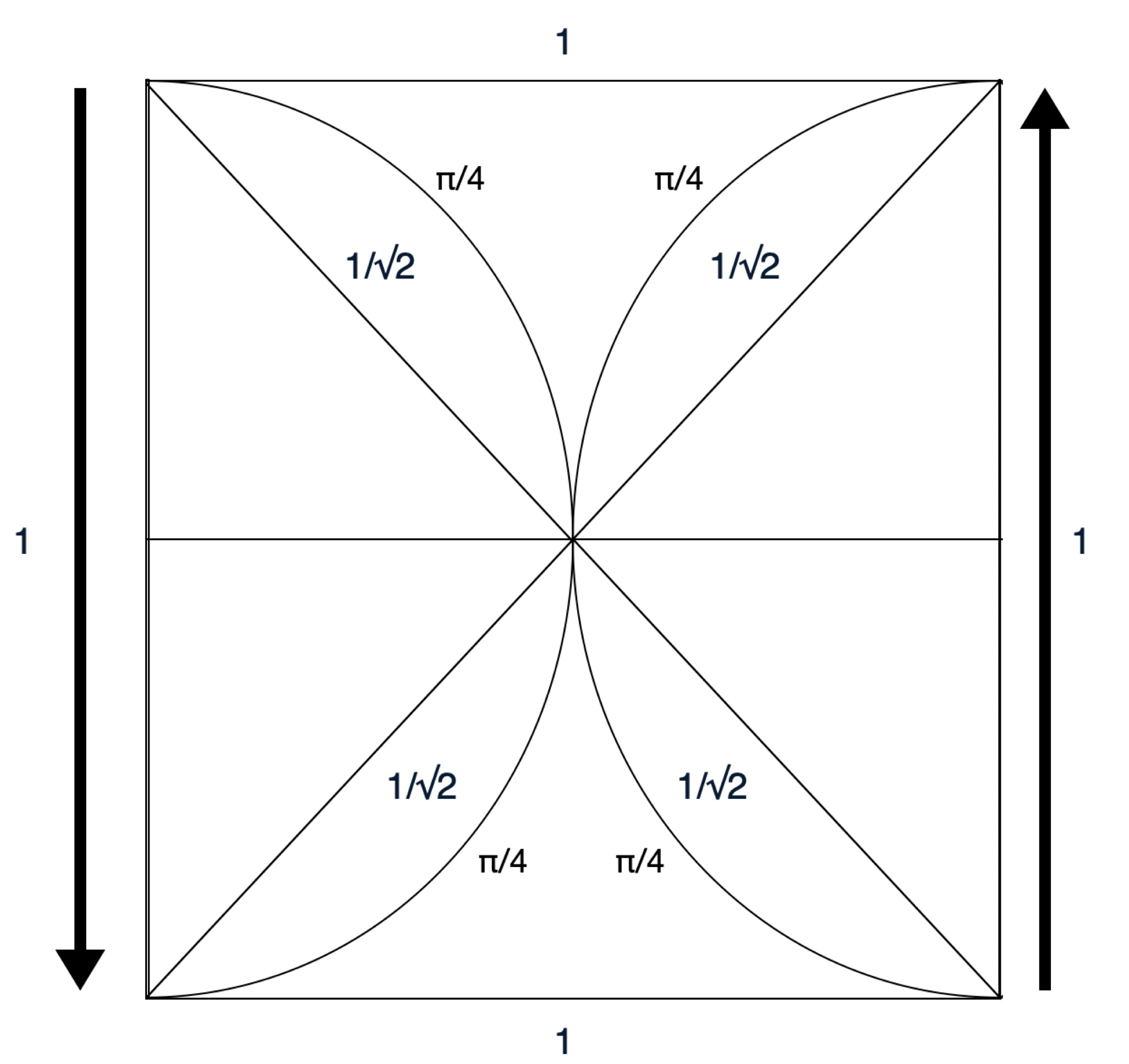
Quantum Geometric Framework.
A unit square (side length = 1) partitioned into four symmetric sectors defined by diagonal radii of
1/√2 and quarter-circle arcs subtending angles of π/4. The construction highlights the intrinsic
relationship between √2—the diagonal scaling factor emerging from Euclidean symmetry—and π—the
measure governing rotational curvature. Their intersection within a normalized geometric field illustrates how linear
extension and circular curvature co-define structure. In this framework, the interplay between √2 and
π is proposed as a foundational geometric tension from which spatial coherence, symmetry breaking, and
emergent physical order may be understood.
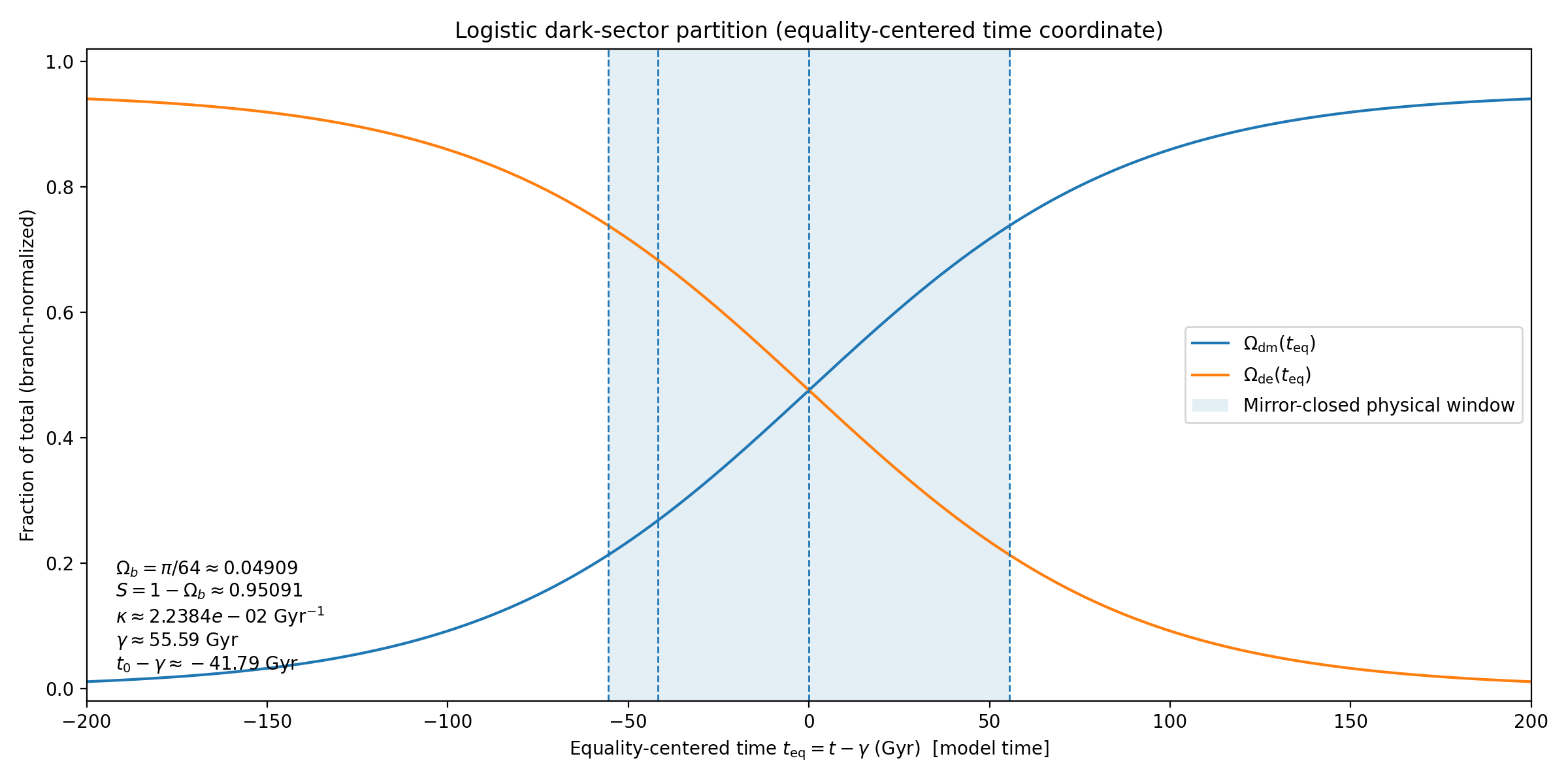
Logistic Evolution of the Cosmos.
Logistic evolution of the dark-sector composition, shown as a function of the equality-centered time coordinate
\(t_{\rm eq}=t-\gamma\) so that dark-sector equality occurs at \(t_{\rm eq}=0\). The mirror-closed physical branch-epoch corresponds to
\(t_{\rm eq}\in[-\gamma,+\gamma]\), i.e. from emergence (\(t=0\Rightarrow t_{\rm eq}=-\gamma\)) to the mirror endpoint
(\(t=2\gamma\Rightarrow t_{\rm eq}=+\gamma\)). Values outside this interval represent analytic continuation/bookkeeping rather than an
extension of a single classical branch.
“What, if some day or night a demon were to steal after you into your loneliest loneliness
and say to you: ‘This life as you now live it and have lived it, you will have to live once
more and innumerable times more’ ... Would you not throw yourself down and gnash your
teeth and curse the demon who spoke thus? Or have you once experienced a tremendous
moment when you would have answered him: ‘You are a god and never have I heard anything
more divine.’”